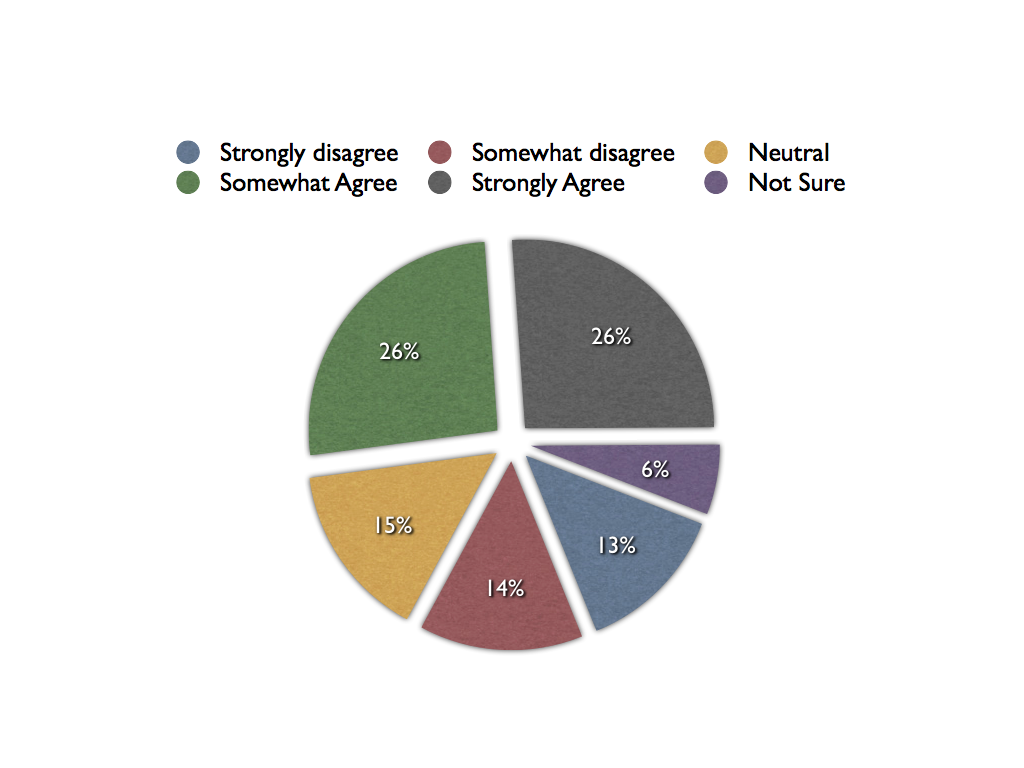
In a recent poll conducted by Zogby, 2,100 adults in the U.S. were asked the following question.
Do you agree or disagree with medical and scientific research that requires lab animals?
The results showed a similar outcome to that of other recent polls.
About 52% of the population approve of animal research in various degrees, about 27% disapprove in various degrees, 15% are neutral and 6% are unsure about their position.
Despite the many polls done on the subject it remains unclear on what grounds do some people object to the use of animals in science.
Is it perhaps that they find the work morally wrong? Is it that they believe all living beings have the basic rights to liberty and freedom?
Some insight into these questions can be gained by asking the same group of people what would the do in the following scenario.
Suppose you suffer from a leaky heart valve, and that doctors say you have two years left. You could have a valve replacement surgery that might save your life. But, in order to obtain the replacement tissue necessary for a surgery, a pig must be killed.
Which of the following statements best reflects what you would do if faces with a similar situation?
Statement A: I would have the surgery. I think it is ethical.
Statement B: I would have the surgery, but I think it is unethical.
Statement C: I would not have the surgery, but I think it is ethical.
Statement D: I would not have the surgery because I think it is unethical.
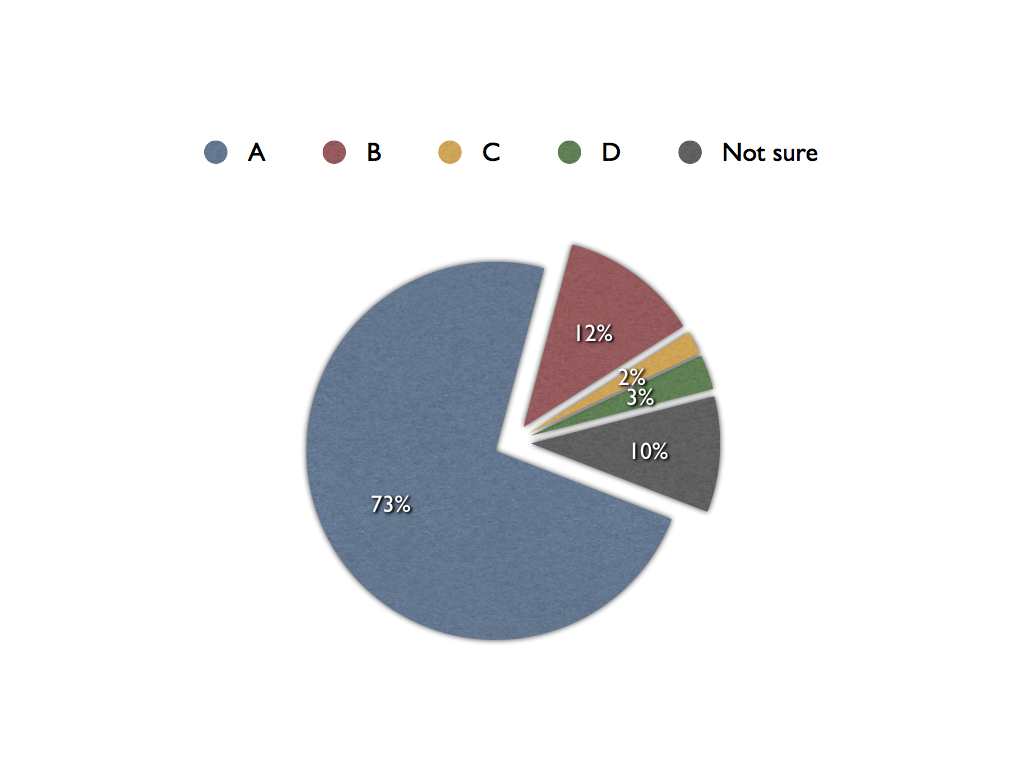
Here are the results from the same poll:
Now, if one believes animals have rights they surely ought to be respected. If you believe a pig has the same basic rights to life and freedom as your neighbor, then you ought to refuse the surgery for the same reason that you would not kill your neighbor to save your own life.
However, only a mere 3% of those asked appear ready to act in a way consistent with such a position. It is interesting to note that also about 3% of the US population are vegetarian, although most of them do it for health reasons and not ethical objections to the use of animals as food.
Thus, those that oppose research do not appear to do so because of belief that all living beings have the same basic rights to life as that of fellow humans.
Another small minority, 2%, would not have the surgery despite the fact they think such surgical intervention is ethical. It would appear this group simply is uncomfortable with the notion that pig tissue would be implanted in their human hearts.
About 12% of the group would opt to save their lives despite having ethical objections. It appears this group feels there is something inherently wrong in killing an animal to allow them to survive and yet, if faced with the situation they would nonetheless go ahead with the surgery. Arguably, this group realizes that the pig is a living being that we owe moral concern, but that when human and animal lives are at stake, opting to save the human is morally permissible. Alternatively, they may genuinely opt for behaving in an immoral fashion when it comes to saving their own lives.
Finally, the vast majority, 73% of them, will opt for the surgery without having any moral concerns whatsoever. None at all. That is roughly 3 out of 4 people in the US population.
A natural question is then why wouldn’t the same group, at the very least, be in favor of animal research that advances medical knowledge and human health?
One likely possibility is that they fail to see the direct link between research and the therapies and medicines that it produces. They fail to see that the medicine that will save their lives next time they visit the emergency room will be, in all likelihood, the result of animal research. They may wrongly perceive basic and translational research as two being completely different things. The contribution of basic knowledge to human health may be lost in translation.
So, what can be done?
Aside from scientists and physicians reaching out to educate the public on this matters, we could begin by labeling each and every single medication that resulted from basic research in animals with such basic information. Note that I am not talking about safety testing in animals — which is required by the law. Instead, I am referring to medicines developed through the identification of molecular targets or the discovery of specific mechanisms with the use of animals in basic research. In other words, I propose to label medicine as derived from animal research if it actually produced the knowledge that actually allowed scientists to understand how a particular therapy could be developed.
Shouldn’t the public be entitled to know where their medicines come from? Shouldn’t the public be entitled to understand the range of benefits produced by their tax dollars?
What do you think?
 Speaking of Research
Your “poll” does not have the correct options. A better test of why people are against animal testing would be:
You will be in need of life saving heart transplant in 20 years time:
1.) Would you like doctors to immediately start killing pigs, cut pieces of their hearts up and try to find a heart valve replacement technology based on these pig valves.
2.) Would you like doctors to attempt to find a heart valve replacement based on human heart valves of patients that’s donated their organs to science
3.) Would you like doctors to attempt to find an artificial heart valve made from synthetic materials that did not require any animal to die.
In this case you will find a much better correlation.
Or, you could have just changed it to a more reasonable version of your poll:
1.) Would you like a bovine or pig based heart valve
2.) Would you like a heart valve from a human heart that was donated to science.
3.) Would you like one of the three different synthetic heart valves available on the market today.
I am sorry — I meant this:
https://speakingofresearch.com/2011/11/17/opponents-of-animal-research-should-refuse-medical-treatment/
Depends on where and who you poll. I found other sites where there were higher percentages of against research. Ironically how many people still die each year of Cancer, Diabetes, Heart Disease, and the 4th largest killer in the US..”Despite rigorous animal tests, prescription drugs kill 100000 people each year, making them our nation’s fourth-biggest killer.” Me thinks there are definitely researchers who falsify data from animal testing results and technically using humans as the so called rat model…Prevention is becoming more knowledgeable to the puvlic every day. More people curing themselves including, doctors, researchers, nurses, lawyers to name a few whose stories are incredible. As such the public are also reading and doing their own research realizing that animal testing, research, vivisection whatever you want to call it is nothing more than a billion dollar market lining the pockets of researchers who have also taken human lives (which I would call extremeists) deceiving the public to get a drug on the market.. You know this happens all the time…………………..
I’d be interested in what other polls you are referring to. Yes, I agree prevention is critical and early education even more. And yet, many people will sometimes behave in ways that they know is detrimental to their health. Even if they want to act responsibly, their economic status may not allow them to do so. And yes, there are deaths that happen for a number of unintended reasons. For example, you forgot to mention those that occur from preventable medical mistakes —
http://www.scientificamerican.com/blog/post.cfm?id=deaths-from-avoidable-medical-error-2009-08-10
http://www.medicalnewstoday.com/releases/11856.php.
This does not imply that physicians or medical professionals do not care about human health. Does it?
It is estimated that the pigs that died in researching seatbelts save roughly a 1000 lives per pig per year in the USA alone. At one point deaths on the roads in cars was so ubiquious that seatbelts (a relatively simple addition) was seen as an insult to the driving skills of the driver. The research coupled with the introduction of the Volvo which sold itself on safety brought about the idea that we should wear seatbelts in cars.
The best example I give as a method by which we reduce animal testing is the Clear Blue pregnancy test. Simple, effective and cheap when compared to the rabbit test of yore. The animal liberation movement (I keep them different from animal rights per se since a lot of animal rights associations like the RSPCA do phenomenal work which I thorouughly appreciate.) manage to pull of their nonsense because there is no concerted equal movement that is willing to campaign on their turf (Yes… We must sink to their level atleast in terms of campaign rather than harassment) against them and correct their ideas in a public arena.
Pro-Test UK was spectacularly effective because it did precisely what this article wants us to do. Go out and educate people. Another good example was the zebra fish adverts from Heart Research UK (I am british so am more familiar with those sides of the argument). It stood in shopping centres, handed out leaflets and basically stood diametrically opposite to PETA and indeed the ALF and other horrid groups of people who firebombed, stole, harassed and mailed razorblades to scientists including an incident where nailbombs were sent through the mail to various scientitsts (The Royal Mail has bomb detection dogs courtesy of the fears over the IRA so these were thwarted).
And I think the same thing has to happen in the USA.
Imagine if you will a man called Mohammed. He wishes to find out the names of staff in a university regarding a certain project regarding comparative religions in a philosophy department. He also runs a website which outright states that he hates people who run the philosophy department due to their comparative religion course and naturally their stance that most religions are man made constructs and Isalm is no different from that. This hatred is not just the dislike we bandy about regarding topics such as “I dislike Manchester United and think they smell” but the website and it’s readers threatens a future where the philosophy department and it’s students live in terror as they are tortured, sexually violated, assaulted and killed.
Now do you think that this man would be able to get a list of staff and students and workers from the university? Do you think a court of law would rule in his favour?
Not a chance in hell… Hell in your country they would probably lock him up for sprouting the hatred that we see. Yet we see that Florida has forced the University of Florida to submit documents containing precisely these details to Camille Marino and her NIO. Why? Hell! Yet we see that Dr. (hah!) Stephen Best still lectures at a university despite writing horrid hate speech. If the man was called Mustafa he would be in serious trouble for incitement of terrorism but frankly even the worst islamic terror threat (in my experience) has been beheading. Dr. Stephen’s letters show the kind of inventive psychopathic torture we are more accustomed to in horror movies.
Because animal lib hasn’t physically hurt someone in the USA yet (In the UK they injured a politician with a firebomb). So they are seen as a comical threat, a bunch of stupid hippy vegans who are all bark and no bite. And nothing will be done until it’s too late and some poor sod (probably some student because they are the easiest target) gets injured or killed by someone who believes in the kind of nonsense that we find in the movement. Because a large amount of people buy into the idea that we are the modern day Dr. Moreaus of the world and that is because we aren’t willing to draw a line and tell poeole what goes into the simplest of medications.
Otherwise PETA will keep going around telling people that we have magic computers out there that can simulate an entire working human body (we don’t. My friend is working on a PhD to simulate a human heart and that’s slow going as it is let alone something more complex like your nervous system). Otherwise Camille will keep harassing people (People have been calling up and harassing people in Florida and one of the Professors names has been linked to his children and indeed the school they attend with threats ranging from “leaflet school” to “do horrible things to their kids”.
In short, I fear that at some point someone will be injured or killed by the animal liberation movement. Why wait till that point? We should educate those who use our drugs and the public about how research works from a young age so as to realise the necessity of usage.
So you are of the opinion that putting live pigs in a vehicle and crashing them at high velocity into a solid concrete wall made a huge difference in the design of seat-belts?
If engineers require inflicting incredible pain and harm to pigs to be able to design something like a seat-belt meant for humans with significantly different anatomy to pigs I am very disappointed in those engineers. Crash test dummies are much better instruments to use for testing safety features. I think even a crude doll made of clay would be a better means to test a seatbelt than a pig.
The fact of the matter is – if humans value the lives of animals they would find other ways to further technology that does not require harming animals.
You may argue that today we don’t have the technology to effectively test medicines and procedures without using animals – but my response would be that it is because nobody has put any effort into developing such technology. If, from the very beginning, animals were not seen as tools that can be used and tortured in any way seen fit by humans, then we would have had even better tools for advancing medicine without the use of animals than we have today. We as a society must make the mental shift to move in the right direction. We must stop perpetuating the idea that we can do whatever we want to animals in the name of saving the lives of some humans.
Have you watched videos of animals being used as crash test dummies? What would your opinion be if 3 year old humans were used in these tests? Or perhaps, if you have similar beliefs as the author, you could justify using mentally handicapped humans if there wasn’t access to anything “less cognitive”?
“We must stop perpetuating the idea that we can do whatever we want to animals in the name of saving the lives of some humans.”
Again, I am not sure who ever said we can do anything we want to the animals. No, I don’t think we an do anything we want. Never said that. It is intellectually dishonest to suggest that if I don’t agree with you I must be a Cartesian.
As for your knowledge of biomechanics it seems rather incomplete. I take you are not an engineer either.
Finally, it is us, scientists, that are developing the alternatives to animal research.
Not you, not Prof. Francione, not HSUS, nor PeTA, nor the ALF.
Scientists are.
As a matter of fact I am an engineer and I’m not all that bad at mechanics – not that I specialized in biomechanics, which I presume you did? But I have some family that did do post-graduate studies in biomechanics and I could ask them about their opinion on whether it would have been essential to use pigs in the development of an effective seatbelt.
Clearly, if you are defending the idea to submit pigs to this type of cruelty to develop a seatbelt, you are saying exactly that you are willing to do whatever you want to animals to save human life.
I am not sure where this question about pigs comes from… My understanding is that today nobody uses pigs in crash tests any more — we have advanced dummies along with the older data. But back in the early days they did use pigs. Fully anesthetized pigs which are euthanized after the test. And the seat-belt has over ~250,000 human lives in the US alone since 1975. I do not know the exact numbers of pigs used, but probably only a tiny fraction of what the number of pigs eaten by the US population every year.
So you are of the opinion that putting live pigs in a vehicle and crashing them at high velocity into a solid concrete wall made a huge difference in the design of seat-belts? ….. (snip) ….Crash test dummies are much better instruments to use for testing safety features.
1 – Yes it did. BTW, the pigs were anaesthetized during and after the crash – they were not aware of the crash or the injuries. (we studied various animal experiments in one of my uni courses, and this was one) And pigs have a chest and abdominal anatomy that is not so different from humans that it makes the information useless.
2 – They are now. However, at the time the first seat belt research was being done, the crash test dummies of which you speak were not available. They were developed after the need for auto safety features was established, AND after the electronics industry developed sensors and equipment capable of collecting the data AND after materials to build the dummies bodies and appendages was developed AND after animal testing (and human cadaver testing) showed what forces were important to monitor.
You can’t walk into a lab and make a replacement for or a computer simulation of something without first studying what you are modelling. In full detail.
Not entitled to know, *obligated* to know.
Great analysis of the fundamental hypocrisy that underlies so many people’s positions on medications and the way they have been developed.
What is really fascinating is the underappreciation of leverage. The pig valve is one-to-one….in research, one animal used may benefit thousands or millions of people over time.